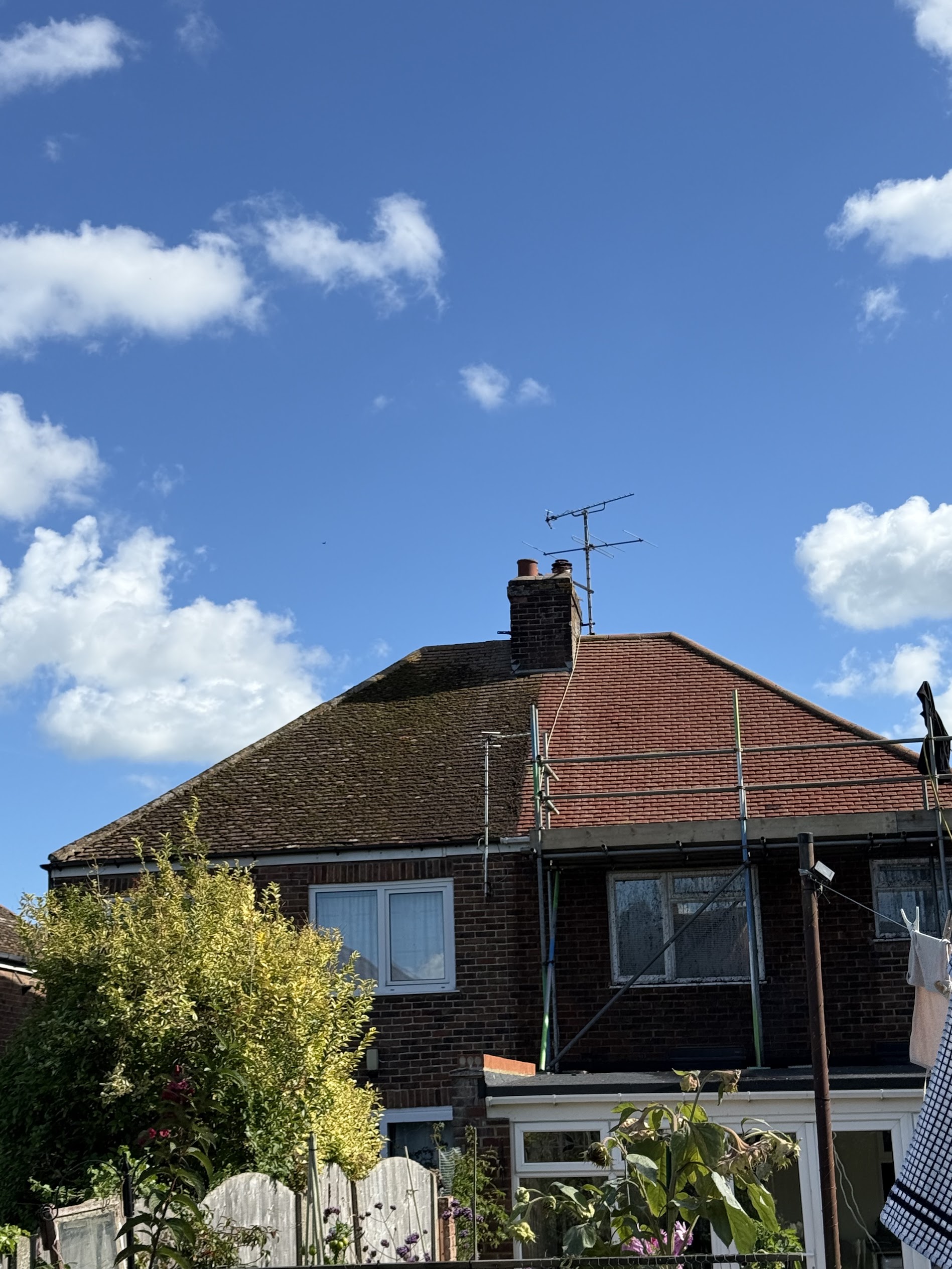
Roof cleaning removes moss, algae and built-up grime to keep your roof looking good and well maintained. The right time, method and a reputable cleaner all make a big difference.
A biocide treatment is the part of a roof clean that stops moss and algae coming straight back. It kills the spores that physical removal leaves behind and slows regrowth for years rather than months. Understanding what a biocide does, what it does not do, and what to check on the quote helps you judge whether the treatment you are being offered is worth what it costs — or whether it is a add-on that adds nothing.
What a biocide treatment does
A biocide is a chemical product designed to kill living organisms — in the context of roof cleaning, the moss, algae and lichen that grow on tiles. Applied after physical moss removal, it kills the spores and root structures that scraping and brushing leave behind. Without it, the moss will regrow from those residual spores within months, particularly on a shaded or north-facing slope. With it, regrowth is slowed for years, because the spores that would restart the cycle are gone.
The result is not instant. Unlike pressure washing, which produces a visible change on the day, a biocide works over weeks. The moss or algae that remains after the physical clean gradually dies back, discolours and washes away over the following weeks and months as rain and weathering break it down. That slow process is normal — it means the product is working rather than being wasted on a surface that will be stripped clean by the next shower.
How the treatment is applied
Biocide is usually sprayed onto the roof surface at low pressure, either from a backpack sprayer for a small roof or a pump-fed lance for a larger one. The product is diluted with water according to the manufacturer's instructions — the dilution ratio matters, because too strong a mix can stain render or kill planting below, and too weak a mix will not kill the spores effectively. A competent contractor will tell you the product name, the dilution and the application rate if you ask.
The roof needs to be reasonably dry at the time of application. If the tiles are saturated, the biocide will dilute further on contact and run off the surface before it has time to work. That is why treatment is often scheduled for a dry spell — not because it is impossible in damp weather, but because the result is better when the product can sit on a dry surface and do its job. Our guide to how long roof treatment takes explains the timeline in detail.
What to check on the quote
A biocide treatment should not be a mystery line item on a quote. You should be able to see the product name, the dilution, the application method and the precautions the contractor will take to protect your garden, your pets and any rainwater collection system. If the quote says 'biocide treatment included' with no further detail, ask for the specifics — a contractor who knows their product will happily tell you what they use and why.
Some biocides are approved for use near watercourses and wildlife; others are not. If you have a pond, a stream, or a rainwater butt connected to the roof drainage, tell the contractor so they can choose a compatible product or plan the run-off carefully. The same goes for pets and children — most roof biocides are safe once dry, but the drying time and any exclusion period should be on the quote.
- The product name and its active ingredient.
- The dilution ratio and the application rate.
- Whether the product is approved for the covering and the environment.
- How run-off, pets, ponds and rainwater collection will be protected.
- Whether a top-up is included in the price or charged as a separate visit.
- The expected drying time and any exclusion period for people and pets.
What a biocide does not do
A biocide is not a permanent barrier against future growth. It kills the spores that are present when it is applied, but it cannot prevent new spores from settling on the roof afterwards — and in the UK climate, with wind-blown moss spores and persistent damp, new spores will arrive. What the biocide does is reset the clock: instead of regrowth within months, you get years before moss re-establishes to the point where another clean is needed.
It is also not a substitute for physical moss removal. A biocide applied to a thick mat of moss will eventually kill the growth, but the dead moss will sit on the roof, hold moisture against the tiles and block drainage until it weathers away — which can take a season or more. That is why most contractors remove the heavy growth first and apply the biocide as a finishing treatment, not a standalone one.
Is a biocide treatment worth it?
If moss is the problem, yes. Physical removal without treatment is a temporary fix — the spores are still there, the conditions are still there, and the moss comes back. A biocide breaks that cycle. The question is whether the price the contractor is charging is fair for the product, the application and the result. If the biocide is a vague 'treatment included' line with no product name or dilution, you are paying for something you cannot evaluate. If the contractor can tell you what they use, how they apply it and what to expect, the treatment is likely worth paying for.
For maintenance planning, pair the treatment with an understanding of how often your roof actually needs attention. Our guide to how often a roof should be cleaned helps you judge frequency from condition and drainage rather than a fixed sales schedule.
FAQs
Get a roof cleaning quote
Compare local, trusted roof cleaning professionals and get a free, no-obligation quote for your home.
One local roof cleaner. No obligation to book.
Related homeowner guides
Roof Cleaning Methods: Soft Washing vs Pressure Washing
Expert UK advice on methods, costs and protecting your roof tiles.
Roof Moss Removal: Methods, Costs and When to Act
Expert UK advice on methods, costs and protecting your roof tiles.
How Long Roof Treatment Takes
Expert UK advice on methods, costs and protecting your roof tiles.
Written & reviewed by
Andrew Hampton
Roofcleaning.uk editor
Andrew Hampton has spent the last seven years working in the gutter and roof cleaning industry, helping homeowners across the UK understand what a proper clean involves, what it should cost, and how to spot a reliable contractor. He edits every guide on Roofcleaning.uk to make sure the advice is practical, up to date, and written in plain English.
- 7+ years in the gutter cleaning and roof cleaning industry
- Edits and reviews every homeowner guide published on Roofcleaning.uk
- Works directly with approved contractors to keep pricing and methods accurate
Last reviewed 1970 · Roofcleaning.uk editorial team