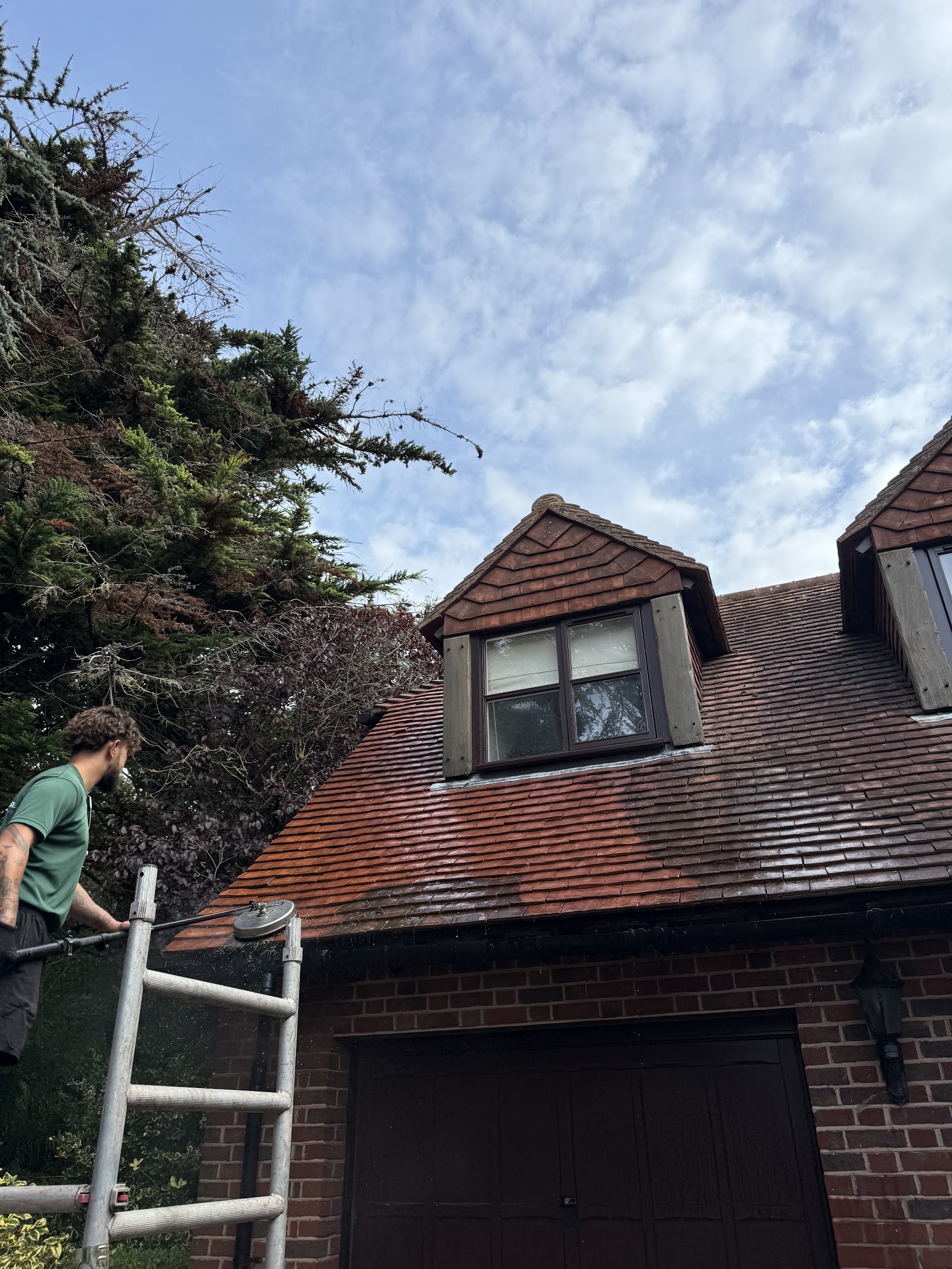
Roof cleaning removes moss, algae and built-up grime to keep your roof looking good and well maintained. The right time, method and a reputable cleaner all make a big difference.
Concrete tiles, clay tiles, slate, flat roofs and thatch each need a different approach. The method that suits a robust concrete interlocking tile will ruin a fragile clay plain tile or an old slate. Matching the method to the covering is the single most important decision in roof cleaning — and it is the one most contractors get wrong when they treat every roof the same.
Concrete interlocking tiles
Concrete interlocking tiles are the most common roof covering on UK homes built from the 1960s onwards, and they are the most robust material to clean. The tiles are thick, interlock at the edges and can tolerate a range of cleaning methods — but that does not mean anything goes. The protective granules on a coated concrete tile can be stripped by high pressure held too close, exposing the bitumen backing underneath and shortening the tile's life.
Low-pressure washing, soft washing with a biocide, and manual moss removal are all viable approaches on a sound concrete roof. The question is whether the tiles are in good enough condition to take the method — aged or porous concrete can spall under a direct jet, and a tile that is already crumbling at the edges needs a gentler approach than one that is still sound. A contractor should assess the condition before choosing the method.
Clay plain tiles
Clay plain tiles are the classic British roof covering — the small, flat, overlapping tiles you see on Victorian and Edwardian terraces and on many period properties. They are beautiful, but they are fragile. The tiles are thin, they are laid with a steep pitch, and they crack under body weight, particularly when they have aged and become brittle. Marley's own clay tile guidance explicitly warns against both pressure washing and scraping moss from the surface.
Soft washing with a biocide, applied from ladders with stand-offs or from a scaffold tower, is the safest approach for most clay roofs. The contractor should keep their weight off the tiles entirely where possible, using a telescopic lance rather than walking the slope. If a contractor tells you they will pressure-wash a clay tile roof, that is a red flag — it shows they have not thought about the covering or checked the manufacturer's guidance.
Slate
Slate is the most fragile common covering when it is old. Weathered slate delaminates — the layers separate — and the fixing nails corrode over decades, so a slate roof that looks sound from the ground may be brittle and loose underfoot. Walking on an old slate roof is a genuine risk: a boot on the wrong slate will crack it, and a cracked slate is a leak waiting for the next heavy rain.
The safest approach on a slate roof is to keep the operator off it entirely. Telescopic lances, cherry pickers and scaffold towers all allow moss removal and biocide application without anyone stepping on the slate. If the slate is in poor condition — delaminating, cracked or missing — the roof may need repair before it needs cleaning, and a contractor who flags that rather than offering to clean over the damage is worth listening to.
Flat roofs and membranes
Flat roofs — felt, EPDM rubber, fibreglass (GRP) or single-ply membranes — are the standard commercial roof covering, and they are appearing on more domestic extensions and garages too. None of these surfaces can take pressure washing. A jet that lifts moss from a concrete tile will score a felt roof, tear an EPDM seam or shatter the gel coat on a fibreglass canopy. Flat roofs are cleaned with gentle mechanical clearance and a biocide, not pressure.
The bigger risk on a flat roof is drainage. Flat roofs rely on outlets and downpipes that sit flush with the surface, so a modest amount of moss and leaf litter can seal them shut. Water that has nowhere to go ponds on the membrane, and ponding is the single biggest cause of premature flat-roof failure. Keeping the outlets clear is not cosmetic — it is how you protect the warranty. Our commercial roof cleaning guide covers this in more detail.
Thatch, metal and heritage materials
Thatch, metal roofs (copper, zinc, lead or coated steel) and heritage materials like peg tiles or handmade clay all need specialist consideration. A generic pitched-tile cleaning package is not the right approach for any of them. Thatch should never be pressure-washed or treated with a standard biocide; metal roofs react to chemicals that are harmless on tile; and heritage coverings may be protected by listed building consent that restricts what can be done.
If your roof falls into any of these categories, find a contractor with specific experience of the material — not a general roof cleaner who offers to 'have a go'. The right specialist will tell you what can and cannot be done safely, and they will be honest if the answer is that the roof should be left alone.
FAQs
Get a roof cleaning quote
Compare local, trusted roof cleaning professionals and get a free, no-obligation quote for your home.
One local roof cleaner. No obligation to book.
Related homeowner guides
Does Roof Cleaning Damage Tiles?
Expert UK advice on methods, costs and protecting your roof tiles.
Roof Cleaning Methods: Soft Washing vs Pressure Washing
Expert UK advice on methods, costs and protecting your roof tiles.
Commercial Roof Cleaning
Expert UK advice on methods, costs and protecting your roof tiles.
Written & reviewed by
Andrew Hampton
Roofcleaning.uk editor
Andrew Hampton has spent the last seven years working in the gutter and roof cleaning industry, helping homeowners across the UK understand what a proper clean involves, what it should cost, and how to spot a reliable contractor. He edits every guide on Roofcleaning.uk to make sure the advice is practical, up to date, and written in plain English.
- 7+ years in the gutter cleaning and roof cleaning industry
- Edits and reviews every homeowner guide published on Roofcleaning.uk
- Works directly with approved contractors to keep pricing and methods accurate
Last reviewed 1970 · Roofcleaning.uk editorial team