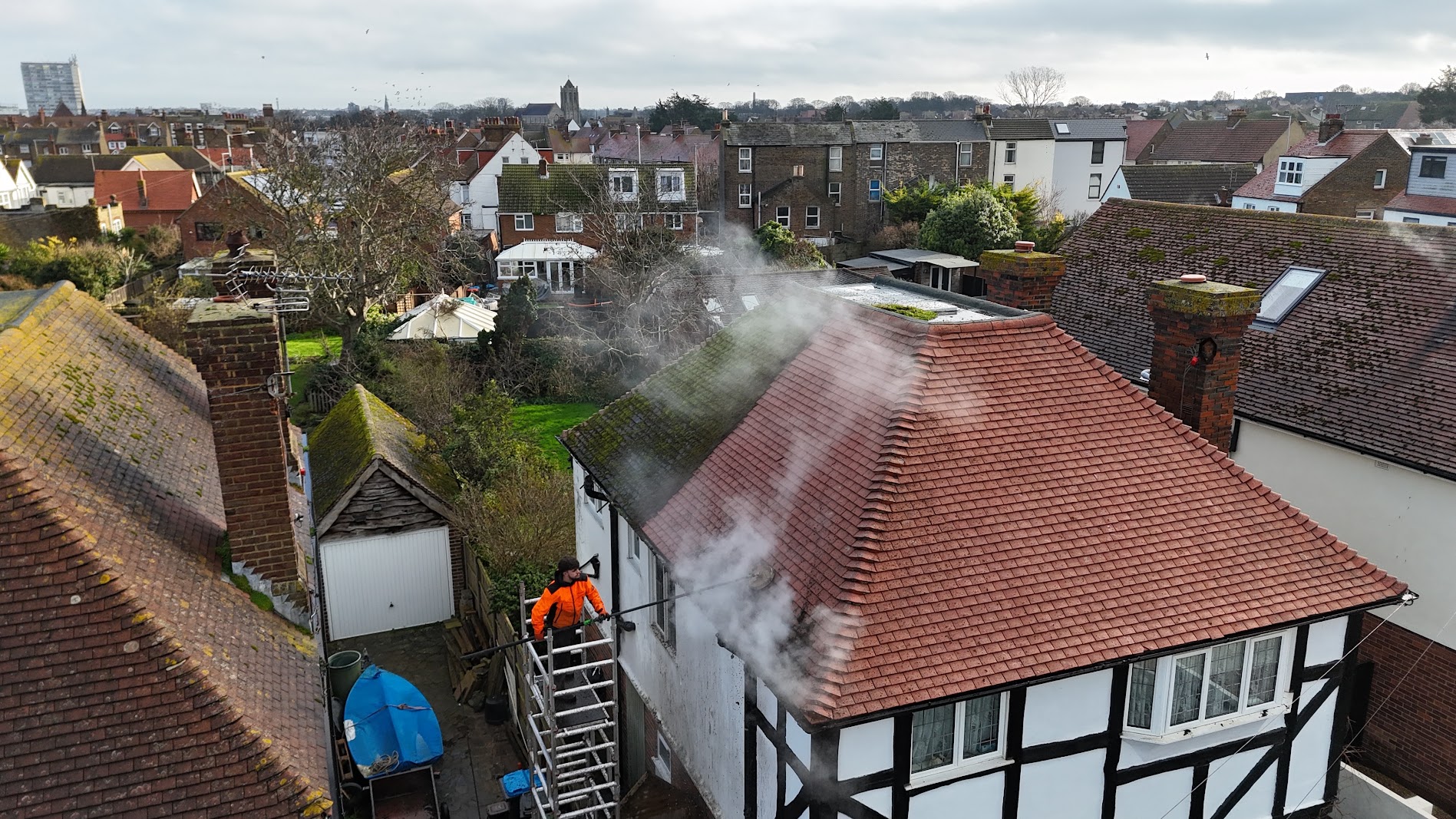
Roof cleaning removes moss, algae and built-up grime to keep your roof looking good and well maintained. The right time, method and a reputable cleaner all make a big difference.
Commercial roofs take more punishment than domestic ones — flat membranes, constant moss pressure, and drainage that quietly blocks until water finds a way in. This guide explains how commercial roof cleaning differs from a standard domestic clean, what to expect from a quote, and how to schedule work without closing your doors.
Why commercial roofs need a different approach
Most commercial buildings have flat or low-pitch roofs — felt, EPDM rubber, fibreglass (GRP) or single-ply membranes. These surfaces cannot take pressure washing. A jet that lifts moss off a concrete tile will score a felt roof, tear an EPDM seam, or shatter the gel coat on a fibreglass canopy. The method has to match the material, and the contractor has to know the difference before they set foot on the roof.
Commercial roofs also cover a much larger area than a typical house. A warehouse roof can run to thousands of square metres, which changes everything about access, debris handling and the time the job takes. A clean that finishes a semi in half a day can take a full week on a distribution unit, with a different crew, different plant and a far bigger skip.
Then there is the drainage. Flat roofs rely on outlets and downpipes that sit flush with the surface, so a modest amount of moss and leaf litter can seal them shut. Water that has nowhere to go ponds on the membrane, and ponding is the single biggest cause of premature flat-roof failure. Keeping the outlets clear is not cosmetic — it is how you protect the warranty on the roof.
What a commercial clean actually covers
A proper commercial roof cleaning visit is really three jobs bundled together. First, the clearance: loose moss, leaves, bird debris and anything else sitting on the surface or blocking the outlets. Second, the treatment: a biocide applied to the membrane to kill the algae, lichen and moss spores that are already rooted into it. Third, the drainage check: making sure every outlet runs clear before the crew leaves.
- Mechanical clearance of moss, leaves and surface debris.
- Gentle biocide treatment matched to the membrane type — felt, EPDM, GRP or single-ply.
- Clearing and flushing of all roof outlets, downpipes and scuppers.
- Inspection of flashings, upstands and seams while the roof is clear.
- A short written report noting any defects spotted during the clean.
Health and safety, and access
Cleaning a commercial roof is a working-at-height activity, and it is governed by the same rules as any other commercial roof work. A competent contractor will method-statement the job, risk-assess the access, and use edge protection or a harness system where the roof edge is unprotected. If the job needs a cherry picker, a tower or a permit to work, those costs belong in the quote — not added on afterwards.
Access is often the deciding factor on price. A roof reachable from a fixed internal staircase is straightforward. A roof that needs a hired access platform, a road closure, or work done out of trading hours costs more, because the plant and the timing both carry a premium. A good quote breaks these out so you can see what you are paying for.
You should also expect the contractor to carry public liability insurance at a level that reflects a commercial risk — typically at least £5 million for a business premises. Ask for the certificate, not just a verbal assurance. It is a standard request and a professional contractor will have it to hand.
Scheduling around your business hours
The biggest practical question on a commercial clean is when the work happens. Pressure on a roof — footsteps, plant, hose runs — is noisy, and on a retail unit or an office that noise travels straight through the ceiling. Most commercial cleans are scheduled either before opening, in the evening, or at a weekend, and the quote should reflect whatever pattern you agree.
Weather matters more on a flat roof than on a pitched one. Biocide needs a dry surface and a dry window to work, and a flat roof is genuinely dangerous when wet. A contractor worth booking will hold a date in the diary and only commit once the forecast is settled, rather than turning up and improvising.
If you run a food business, a healthcare setting, or anywhere with strict hygiene rules, say so up front. The debris handling, the chemicals used and the clearance of the site afterwards all need to meet a higher standard, and the contractor needs to know that before they quote.
What to expect from a commercial quote
A commercial quote should read like a method statement, not a one-line price. You are paying for access, plant, labour, chemicals, debris disposal and a written report — and a quote that does not itemise those is a quote that will move once the job starts. Use a written quote checklist to compare like-for-like.
Expect the contractor to want a site visit before quoting. Aerial images help, but a flat roof with a failed seam or a blocked internal outlet cannot be priced accurately from a satellite shot. A short visit also lets them confirm access, measure the area properly, and spot anything that turns a clean into a clean-plus-repair.
- Measured roof area and the method chosen for each surface.
- Access plan — stairs, tower, cherry picker — and what it costs.
- Biocide product and dilution, with a note on membrane compatibility.
- Debris disposal route and whether a skip or bagged collection is included.
- A written report of any defects found during the clean.
How often should a commercial roof be cleaned?
There is no single answer, because it depends on the roof, the location and the surrounding trees. A flat roof under heavy tree cover in a damp climate may need attention every 18 months; a well-drained warehouse roof on an industrial estate might go three years between visits. The right frequency is the one that keeps the outlets running and the moss from getting established — not the one that waits until there is a problem.
A good contractor will tell you honestly what they found and when they would next expect to return, rather than selling you an annual contract you may not need. If you want a framework for deciding, read our guide on how often a roof should be cleaned and adapt it to your building.
FAQs
Get a roof cleaning quote
Compare local, trusted roof cleaning professionals and get a free, no-obligation quote for your home.
One local roof cleaner. No obligation to book.
Related homeowner guides
Roof Cleaning by Material: A Guide for Every Roof
Expert UK advice on methods, costs and protecting your roof tiles.
Roof Biocide Treatment Explained
Expert UK advice on methods, costs and protecting your roof tiles.
How Often Should a Roof Be Cleaned?
Expert UK advice on methods, costs and protecting your roof tiles.
Written & reviewed by
Andrew Hampton
Roofcleaning.uk editor
Andrew Hampton has spent the last seven years working in the gutter and roof cleaning industry, helping homeowners across the UK understand what a proper clean involves, what it should cost, and how to spot a reliable contractor. He edits every guide on Roofcleaning.uk to make sure the advice is practical, up to date, and written in plain English.
- 7+ years in the gutter cleaning and roof cleaning industry
- Edits and reviews every homeowner guide published on Roofcleaning.uk
- Works directly with approved contractors to keep pricing and methods accurate
Last reviewed 1970 · Roofcleaning.uk editorial team